| MEDICAL INTRO |
| BOOKS ON OLD MEDICAL TREATMENTS AND REMEDIES |
THE PRACTICAL |
ALCOHOL AND THE HUMAN BODY In fact alcohol was known to be a poison, and considered quite dangerous. Something modern medicine now agrees with. This was known circa 1907. A very impressive scientific book on the subject. |
DISEASES OF THE SKIN is a massive book on skin diseases from 1914. Don't be feint hearted though, it's loaded with photos that I found disturbing. |
DISEASES OF THE EYE.
DISEASES OF THE EYE - INTRODUCTION:
Every one who has even a slight acquaintance with the box which a photographer uses, called the camera, can appreciate at once the structure of the eye. The human eye is, indeed, arranged upon precisely the same principles as the photographer's camera, as will be evident upon slight comparison.
The photographic camera consists of a box blackened on the inside, to which light is admitted only through an opening in the front ; this opening is filled by a piece of curved glass, technically called a double convex lens. At the side of the box opposite to this lens is a frame made to carry a plate of glass. This plate 01 glass is coated with a layer of material - usually a compound 01 silver in gelatine-which is sensitive to light; that is, whenever the light falls upon the plate, this material undergoes a chemical change. In taking a picture the object is placed in front of the box in such a position that the rays of light emanating from this object are focused by means of the lens, that is, brought together so as to make a picture upon the plate. In consequence of the sensitive nature of the gelatine upon the glass plate to the action of light, this picture is recorded upon the plate, making the photograph.
The same principles apply in the formation of the picture in the human eye. The eye is a spherical box or camera, blackened on the inside and closed on all sides except in front, where a circular opening exists. Right at this opening is a double convex lens like that of the photographer's camera ; and at the back of the eye is a sensitive plate, a layer of nervous tissue called the retina, which is susceptible to the action of light just like the gelatine of the photographer's plate. The rays of light coming from an object in front of the eye are focused by means of the lens so as to make a picture of that object upon the sensitive plate - the retina - at the back of the eye. This picture excites the nervous center in the brain, so that the individual is conscious of the image on the retina.
The essential parts of the eye - those absolutely necessary to the perception of an object - are therefore the lens and the retina. If either of these be damaged so that it cannot perform its proper functions, there can be no perception of objects by the eye. Yet while these constitute the foundation of the eye, so to speak, there are various other parts of the organ which are essential to perfect vision as it exists in the healthy eye. We can understand these parts by referring again to the photographer's camera. He employs lenses of different power, according to the distance of the object which he wishes to picture upon the plate. If this object be situated close to his camera, the photographer must have a stronger lens - that is, one with a considerable curvature of the surface. This is necessary in order that the picture shall be accurately focused upon the plate at the back of the box. If the object be, on the other hand, situated at a considerable distance, such as an extensive landscape, the photographer uses a weaker lens - that is, one which is not so curved.
Just so there must be a difference in the curvature of the lens in the human eye at different times, for when we read small print for instance, or examine objects situated close to the eye, the rays of light must be strongly focused in order to make a perfect picture on the retina ; and when we look at distant objects the rays of light must be less strongly focused - that is, the lens must be flatter. Now, it is impossible to arrange for the difference in the eye as is done in the photographic camera, for in the latter case a stronger or a weaker lens is put into the opening of the box as occasion requires, several being kept on hand and changed according to the object desired. The eye is provided with only one lens ; but by a most delicate arrangement this lens can be made to change its shape. It becomes more curved or flatter, according as the individual looks at near or distant objects. Thus the same result is produced as if the eye were provided with several lenses of different curvatures ; that is, the object, whether near or far, is focused so as to produce a perfect picture on the retina.
This change in the curvature of the lens is accomplished by the contraction of a muscle - the ciliary muscle. Whenever we desire to look at near objects this muscle contracts, causing the lens of the eye to become more curved. We are not conscious of the effort at first, nor are we aware that we actually change the form of the eye. This is done unconsciously, like so many other movements of the body. But after a time we become conscious that we are exerting an effort; thus if we look at small objects for a considerable time, if we read fine print, for example, the eye becomes tired. This is for the same reason that the arm becomes tired after long-continued muscular effort, or that the legs become tired from walking. Every muscle must be rested after it has worked a considerable time, and it indicates the need for rest by the feeling which we call fatigue. So the eye becomes tired when reading small print, simply because the muscle which keeps the lens in a proper state of curvature has become exhausted.
Another feature, which is common to the eye and to the photographic camera alike, is an arrangement whereby the amount of light entering the eye can be regulated - that is, increased or de creased as occasion requires. The photographer regulates the light which enters his camera by means of a black ring which he puts over the lens, thus shutting out the light from the edge of the lens, and permitting it to enter only through the middle portion. When the light coming from the object is very intense, it is necessary to put this black ring over the lens so as to shut out some of the light.
This is what the photographer calls stopping the lens. A precisely similar arrangement is found in the human eye. The colored ring in the front of the eye - the iris - is really a curtain, intended to regulate the amount of light which passes through the lens onto the retina. Whether blue, or brown, or black, it is so constructed that no light passes through it. Any light which enters the eye must pass through the central opening in the iris - the pupil. Whenever the eye is exposed to a bright light, the iris closes somewhat, so as to make the pupil smaller, and thus permit less light to pass into the eye. Whenever the light is very dim, on the other hand, the iris opens, so as to permit more light to enter the eye. This action of the iris in regulating the amount of light admitted to the eye, is, like the action of the ciliary muscle, an unconscious effort, which may even take place during sleep.
The closure of the pupil has also another object, for, in consequence of the shape of the lens, it is necessary in looking at near objects, to permit the light to pass only through the central part of the lens ; if the rays enter through the edge as well as the middle of the lens, the image formed on the retina is blurred and the individual sees indistinctly. Hence whenever we look at near objects, when we read fine print for example, the pupil contracts quite markedly ; if the eye be suddenly directed from near to distant objects, the pupil increases in size - a change which can be plainly seen if we watch a person who suddenly changes his eyes from a book that he is reading to look at a distant object. This occurs quite independently of the amount of light which enters the eye ; it is intended to increase the distinctness of vision. A simple experiment will illustrate the value of this action of the iris in closing the pupil when we look at near objects. Let an individual close one eye, and holding a pin by its point between the thumb and finger, bring the head of the pin to within about ten inches from the other eye. He will now see the pin head quite distinctly.
Let him then bring it gradually toward the eye, gazing steadily at the head of the pin all the time, when it has been brought to within a certain distance - usually within about three inches from the eye - the image becomes indistinct, that is the pin's head seems blurred. Let the person now take with the other hand a card with a pin-hole in it, and bring this card close up against the eye so that the pin-hole comes just in front of the pupil; upon looking through this pin-hole he will see that the head of the pin which was blurred a moment before is now perfectly sharp and distinct.
This simple experiment shows how important the action of the iris is in enabling us to see near objects distinctly. By looking through the pin-hole we accomplish the same result as if we closed the pupil to the size of the pin-hole, and are thus enabled to see distinctly where we could not see were the pupil large.
The form of the eye is maintained by means of stout mem branes- the outer coat of the eye - and by the fluids which fill its interior. The front part of this outer coat is made smooth and transparent and is called the cornea. This part of the eye is shaped very much like a watch glass ; it is its smoothness and polished surface which give to the eye the brilliant luster so characteristic of this organ. The interior of the eye is lined with a layer of black material - the choroid-the object of which is just the same as the object of the black layer in the photographer's camera or in any other optical instrument - that is to absorb straggling rays of light so as not to blur the image formed by the rays coming directly from the object. It is owing to this black lining that the pupil of the eye appears black, no matter what the color of the iris may be ; for the pupil is merely an opening through which we look directly into the back of the eye; and since this back is made of black material which reflects but little light, it is evident that the pupil must appear to be black. There are certain circumstances under which the pupil may appear red; these circumstances occur when an individual happens to be standing facing a bright light while the observer stands between him and the light. Under such circumstances the pupil will suddenly flash out with a flaming red color, as if the eye were of fire. This appearance is more familiar in connection with the lower animals ; it is frequently observed that the eyes of a dog or cat exhibit this brilliant red color. This redness is simply a reflection from the retina, which lies upon the black coat, the choroid, and has a brilliant red color.
The retina is, as has been said, a layer of nervous tissue which is sensitive to the action of light. Yet it is not equally sensitive over its entire surface ; we are familiar with the fact that the sense of touch is more acute on the ends of the fingers and on the lips than in the middle of the back ; in the same way the sense of sight - that is, sensitiveness to light-is most acute at a little spot directly opposite the pupil. This place is called the yellow spot of the retina, and is the point upon which the picture must be made in order that we shall see objects distinctly. The rest of the retina is susceptible to light, though less so than this central yellow spot. Hence when images of objects are formed upon other parts of the retina than the yellow spot, they are somewhat indistinct; we can readily appreciate this fact by looking intently at some small object on the wall a few feet distant. This small object is seen quite distinctly but other objects on either side of it are but imperfectly seen. In consequence of this arrangement, it follows that the eye must be directed toward any object which we desire to see distinctly. This necessitates some arrangement for moving the eye quickly and easily, in order to view successive objects with great rapidity. Hence the eye is made movable in its socket, and is provided with a series of muscles whose function it is to revolve the eye and thus enable the individual to view different objects in quick succession. In this way the pictures of different objects, located in various directions from the individual, can be readily formed upon the yellow spot, and thus distinctly seen.
It has been several times stated that pictures are actually formed upon the retina, just as they are formed in the photographer's camera. This statement can be easily verified by removing an eye from a freshly-killed animal - a sheep or bullock. If the outer white coat be cut carefully away at the back of the eye, so as to leave the inner coat intact, and the eye then be taken in a dark room and the front of it - the cornea - turned toward a window, a picture of the window-sash and frame will be seen distinctly upon the back part of the eye where the outer coat is cut away. This is what happens in life ; every time that we see an object, an image of that object is actually formed upon the retina.
If, in the experiment just described, the picture in the eye be carefully observed, it will be seen that the image is inverted, that is, the upper pan of the sash appears to be the lower part in the picture. This is also true of the image in the photographer's camera , the picture of a person as formed upon the sensitive plate, is really inverted, so that the individual seems to be sitting or standing on his head. Much speculation has been indulged in at various times in efforts to explain how it is that we seem to see the objects in their proper erect position, though the pictures of them on the retina are upside down. It is not necessary to enter into this discussion ; but simply to remind ourselves that the infant learns to appreciate the relations between the sense of touch and of sight during the first months and years of his existence. Even if there be no other explanation, we may readily assume that after the child has learned by touching objects that they really stand erect he will get into the habit of regarding them as erect, no matter how the pictures are formed on the retina.
The interior of the eye is filled largely with liquids ; one of these, the so-called vitreous humor, occupies most of the eye, and serves to keep the coats of the eye properly filled out. This is a jelly-like substance, which is readily seen by cutting open the freshly-extracted eye of an animal. This vitreous humor is perfectly transparent, and in the natural condition of the eye offers no impediment to the passage of light. But sometimes in diseased conditions of the eye, minute bodies float in this vitreous humor. These bodies seem to the individual to be outside of the eye, and constitute the " specks " before the eyes, which annoy some people extremely.
Another most important part of the optical apparatus is the eyelids. Each of these is moulded out of a substance resembling gristle into the form of a thin plate curved so as to fit over the globe of the eye. These plates of gristle are covered by very fine skin externally, and internally by a delicate mucous membrane called the conjunctiva. A band of muscular fibres passes around the opening of the eye ever the upper lid above and the lower lid beneath, making a somewhat oval or elliptical figure. When these muscular figures contract they draw the two lids together, thus closing the eye, From the borders of the lids there project the eyelashes, which give protection against the entrance of dust and other foreign bodies. Just behind these hairs is a row of minute glands, wrhich produce a greasy material. This oily secretion is very important, since it greases the edges of the lids, and thus prevents the tears from escaping down the cheeks.
This mucous membrane, or conjunctiva, covers the entire eye as well as the under surface of the lids. It is a very important part of the eye, since the moisture which it secretes serves to prevent friction between the eyelids and the globe itself. A considerable part of this moisture is furnished by a gland - the lachrymal or tear gland - which is located at the upper and outer part of the eye. This gland is constantly producing a watery fluid, which under ordinary circumstances is just sufficient to keep the eye moist and to provide for the freedom of its movements. At the other end of the opening between the lids - that is, at the end next to the bridge of the nose - there are two small openings, one on each lid.
These are the openings of very fine hair-like channels which lead into a larger tube or duct. This tube runs downward from the inner angle of the eye into the nostril. These channels afford the natural way of escape for the moisture which is constantly being produced in the eye. It sometimes happens that this duct leading from the eye to the nostril becomes inflamed and stopped up ; in this case the tears - by which we mean simply the moisture constantly produced in the eye - can no longer escape into the nose, and, therefore, flow over the edge of' the lids onto the cheeks.
We have thus mentioned the most essential points in the structure of the eye; and with a clear understanding of these points we can appreciate the usual affections to which the eye is subject, as well as the care and attention which should be bestowed upon them.
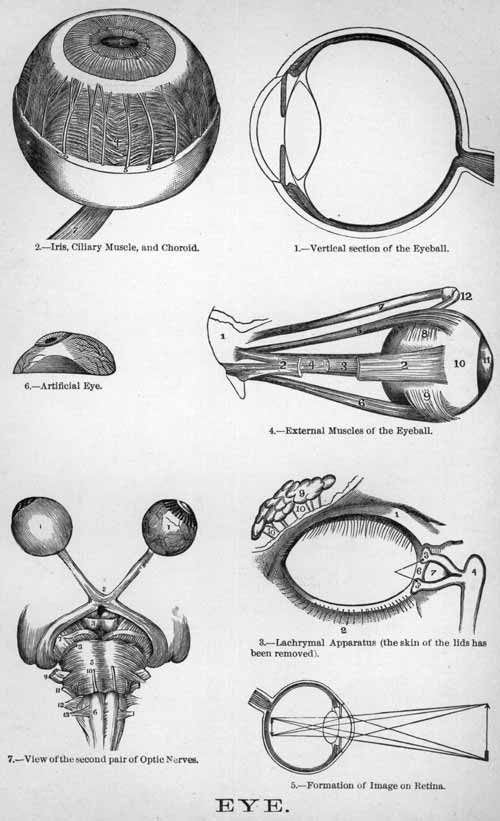
Above is a picture of the human eye and it's nerves.
CONTENTS OF DISEASES OF THE EYE:
-Care of the Eyes in Childhood.
-Weak Sight.
-Foreign Bodies in the Eye
-Short-Sightedness.
-Far-Sight.
-Squinting.
-The selection of Spectacles.
-Inflammation of the Eye - Conjunctivis : symptoms, treatment.
-Purulent Inflammation of the Eyes: symptoms, treatment.
-Gonorrhæal Inflammation of the Eyes: symptoms, treatment.
-Granular Lids: symptoms, treatment.
-Inversion of the Eyelids - Trichiasisy: treatment.
--Scum on the Eye - Pterygium. -Inflammation of the Cornea : symptoms, treatment.
-Ulcers of the Cornea: treatment.
-Inflammation of the Iris - Iritis: symptoms, treatment.
-Cataract: causes.
-Congenital Cataract: treatment.
-Injuries of the Eye: symptoms, treatment.
-Injuries of the Eyelids: remedies, treatment.
-Inflammation around the Eyelashes: treatment.
-Stye: treatment.
-Tumors of the Eyelids: treatment.
-Inflammation of the Tear Duct: symptoms, treatment.
-Artificial Eyes.
-Instructions for persons wearing an Artificial Eye.
But first, if you want to come back to this web site again, just add it to your bookmarks or favorites now! Then you'll find it easy!
Also, please consider sharing our helpful website with your online friends.
BELOW ARE OUR OTHER HEALTH WEB SITES: |
Copyright © 2000-present Donald Urquhart. All Rights Reserved. All universal rights reserved. Designated trademarks and brands are the property of their respective owners. Use of this Web site constitutes acceptance of our legal disclaimer. | Contact Us | Privacy Policy | About Us |